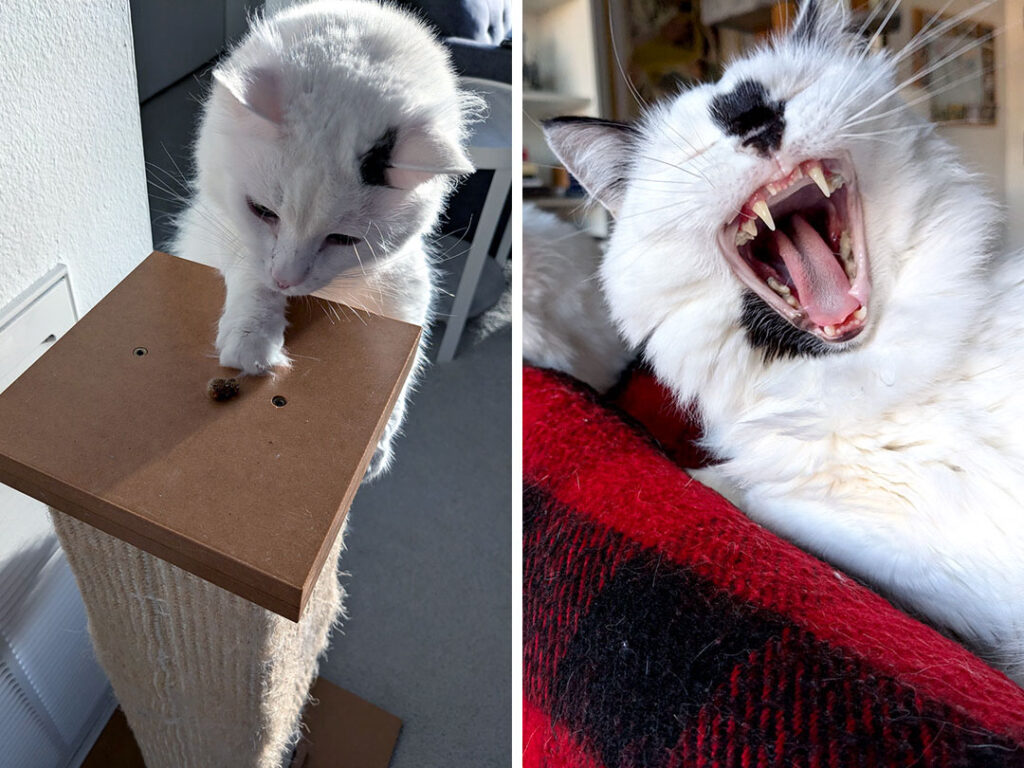
So had the dental treats done nothing? (More on that later.) Fortunately Dr. Tran had a great bedside manner and made space for my “wait, what?!” response, which was a blend of guilty “Should I have been getting their teeth cleaned this whole time,” and confused “How did her teeth get so bad since 2023, I’ve been doing the dental treats, she’s only five years old, and I’ve never had a cat get dental disease before.” Dr. Tran explained that it’s hard to tell with cats, that cats are great at hiding their pain, and that stuff like this can often be genetic so you just get lucky or you don’t. Unfortunately, I’d caught Dr. Tran on her last week at that office, so she needed to transfer Violet’s case to the doctor who was going to be there long enough to get the dental surgery done. She recommended a blood-draw for Violet to rule out any underlying causes, and then I could make a second appointment to meet the other doctor and get the bloodwork lab results.
Dr. Anne’s orders were to SLOWLY switch Violet to a renal diet and add the omega-3 supplement Welactin to her diet. Take one month to transition diets, she said, then leave Violet on the new renal diet for one month, then come back to check if Violet’s SDMA and BUN values had gone down. The problem with doing dental surgery on a cat with kidney disease is that anesthesia is bad for kidneys. So before dental surgery, Violet’s kidneys needed to get better, and that’s most likely to happen with a change in diet. Even then, Violet would still have kidney disease and the less time she was under anesthesia the better. So Dr. Anne recommended I get a dental specialist to do the surgery because they’d be able to do it faster. The vet tech printed out Google Maps entries for two dental specialists in Orange County, then walked me over to the prescription food section of Petco and showed me where the renal food was. I didn’t get the chance to ask my mountain of questions like, “How do you feed two cats different diets?”
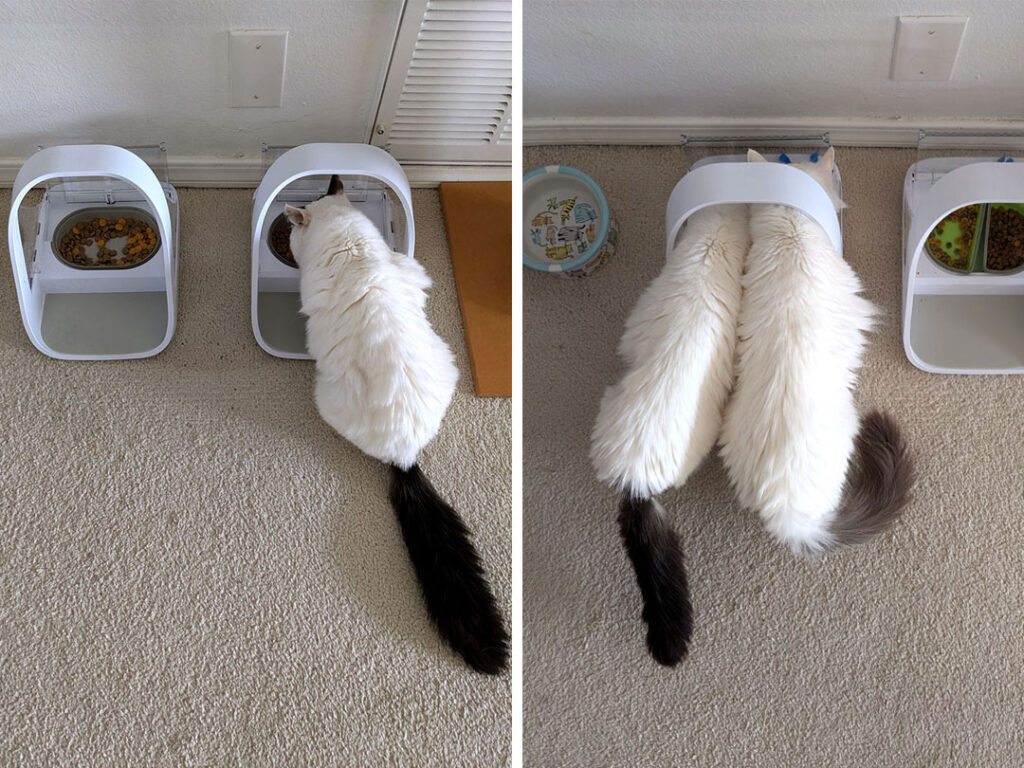
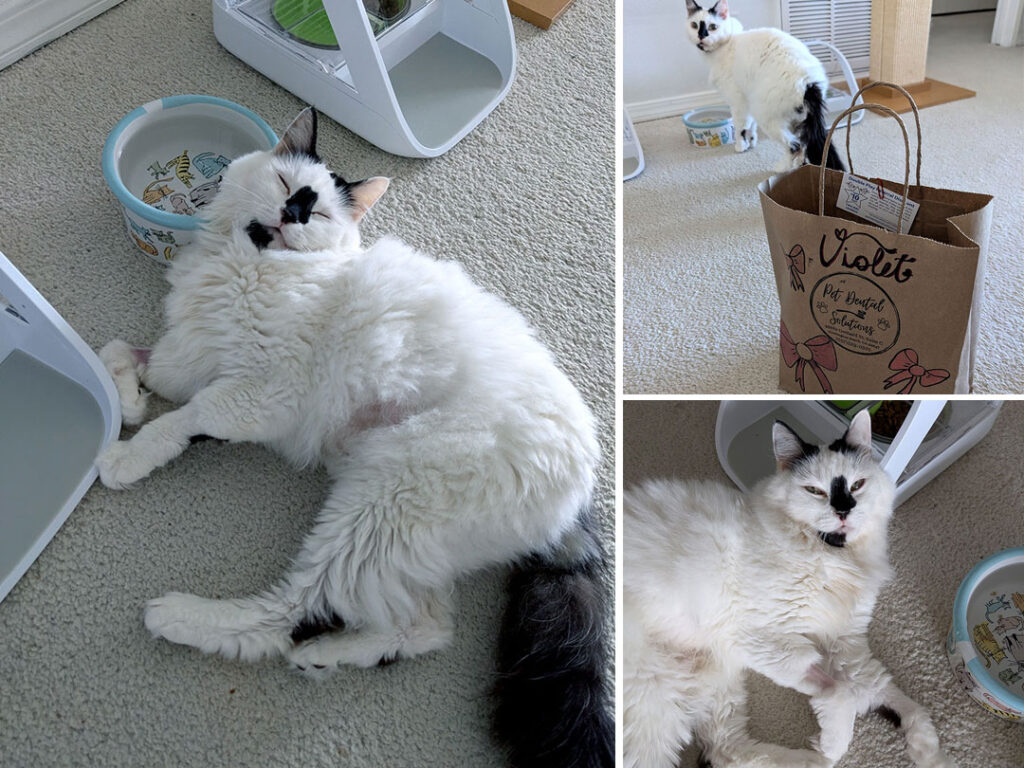
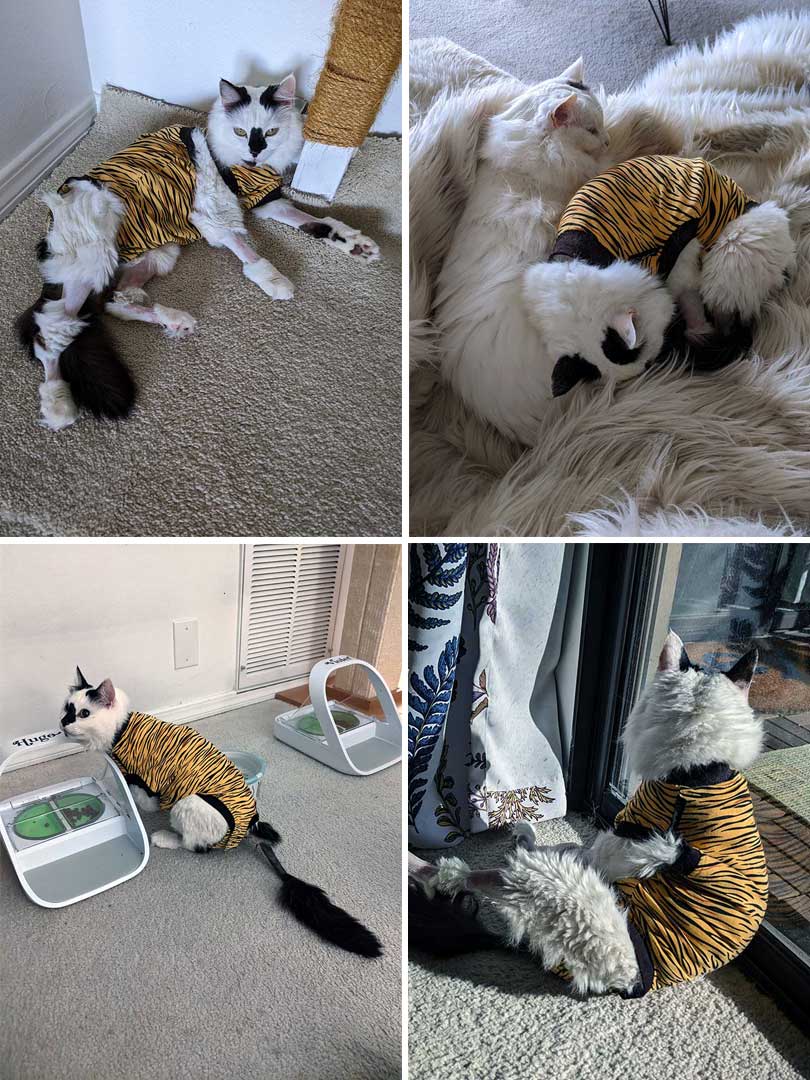
The problem? The feeders work SOME of the time, but not ALL the time. RFID technology is finicky. Is there metal nearby? Or anything electric? The feeder won’t behave as expected. Is there a difference in chip and reader frequency? Is the chip the wrong type? Did the chip migrate to somewhere else inside the cat? The feeder won’t behave as expected. (Does this condo have a space without anything metal or electronic? No, no it does not.) I encountered some unbelievably frustrating things about cat care over the next few months, but for some reason nothing created anxiety the way the unreliable microchip feeders did. At first I thought my feeders were faulty. Violet’s feeder would close randomly while she was eating, and Hugo’s feeder often wouldn’t open at all. I exchanged those feeders only to see the exact same behavior in the new feeders: Violet’s closes, Hugo’s won’t open. So I started working with the company to troubleshoot. After a couple rounds of me sending them these heartbreaking videos of Hugo leaning over his closed feeder looking up for help and them sending button combinations to put the feeder into different modes, they sent a range tester to see if the problem was the feeder sensors. The range tester proved that the feeders worked GREAT, EVERY TIME, and at LONG DISTANCES, the opposite of the way the feeders behaved with the cats. I felt insane. The only way to troubleshoot an issue is to figure out a way to reliably reproduce the problem, and the feeder behavior was consistently unpredictable. Finally I realized the problem was THE OTHER FEEDER. You can’t have them too close to each other (like in these photos). I checked my “other feeder” theory with the company after all our back-and-forth had come to naught, and they said, “Oh. Yeah. By the way, make sure the feeders aren’t next to each other.” So I put the ceramic water dish between the feeders, and now they work most of the time. Hugo’s feeder still doesn’t open sometimes, but it opens often enough that I don’t feel the need to hang around to open it for him anymore. (He’s also gotten good at figuring out how to approach the feeder at different angles until it opens. He starts head-on and if that doesn’t work he backs up, takes a step to the left, then comes in from the side, and that usually does it.) Violet’s feeder will close on her only if the feeder gets too close to the wall behind (you can see there’s a metal grate there). It’s still not as reliable as I’d like, but it’s enough that I feel the cats can be alone for a day.
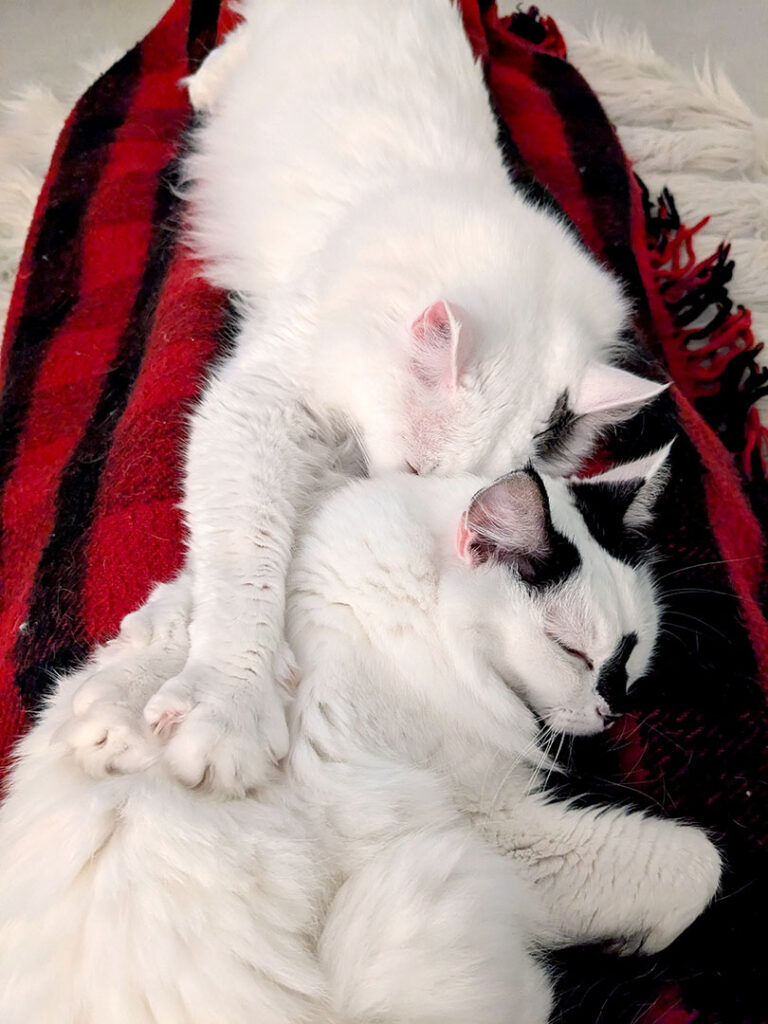
Gabapentin is an anticonvulsant used to regulate seizures in humans, but it turns out you can also use it to manage pain and anxiety in cats. (If you want your pet to be calm on the airplane, you’ll probably get a Gabapentin prescription.) So it’s like a sedative. When Violet started Gabapentin, she slept most of the time with occasional wobbly trips to the food dish. (Gabapentin messes with your balance.) I used to sit there and watch to make sure she was still breathing. Over time she got used to the effects and didn’t sleep as much, but the sedative properties were still evident. It was like the personality had been drained from the cat. (Normally, Violet’s constantly talking and insisting on things that she wants. She’s either crawling onto your lap or setting herself down in easy petting range. On Gabapentin, she hung out under the console table, either sleeping or staring. She didn’t really talk or cuddle anymore.) Plus having Violet on Gabapentin long-term was problematic not only because it was bad for her kidneys but also because the rumor is that cats who have been on Gabapentin for a long time can have seizures if they’re not weaned off it correctly. So I felt motivated to get Violet’s teeth treated and get her off Gabapentin as soon as her kidney situation would allow for the dental surgery.
I didn’t realize it at the time, but Dr. Maki had done me a huge favor by getting that ultrasound booked. It turns out most vet hospitals in Southern California don’t have an ultrasound machine. Instead there’s a traveling technician that visits certain days of the week at unspecified hours. So you have to call the vet who calls the technician. The technician decides if/when they feel like visiting that pet hospital, then calls the vet back and the vet calls you and lets you know when you’ll need to be there. There’s no set schedule from week to week, so you get to be surprised and hope that the technician’s in-office hours overlap with a time you can be there. And the chances that either the technician or the vet don’t call back are high, so high in fact that I never successfully booked an ultrasound on my own and always had to call for help from the referring vet’s office. (It’s months later at this point and I’m still waiting on some ultrasound inquiry responses.) At one point I got so frustrated with the system that I took the morning off work and made a list of every vet in Long Beach and the surrounding communities and called all of them asking about an ultrasound. The response was the same: 1) we don’t have an ultrasound machine but we have a technician that visits sometimes, or 2) if your cat isn’t already a patient at this hospital then you can’t get an ultrasound. (Of all the places I called, only one receptionist offered the names of some other places that might be able to do the ultrasound. That one place was Belmont Shore Veterinary Hospital in Long Beach, more on them later.)
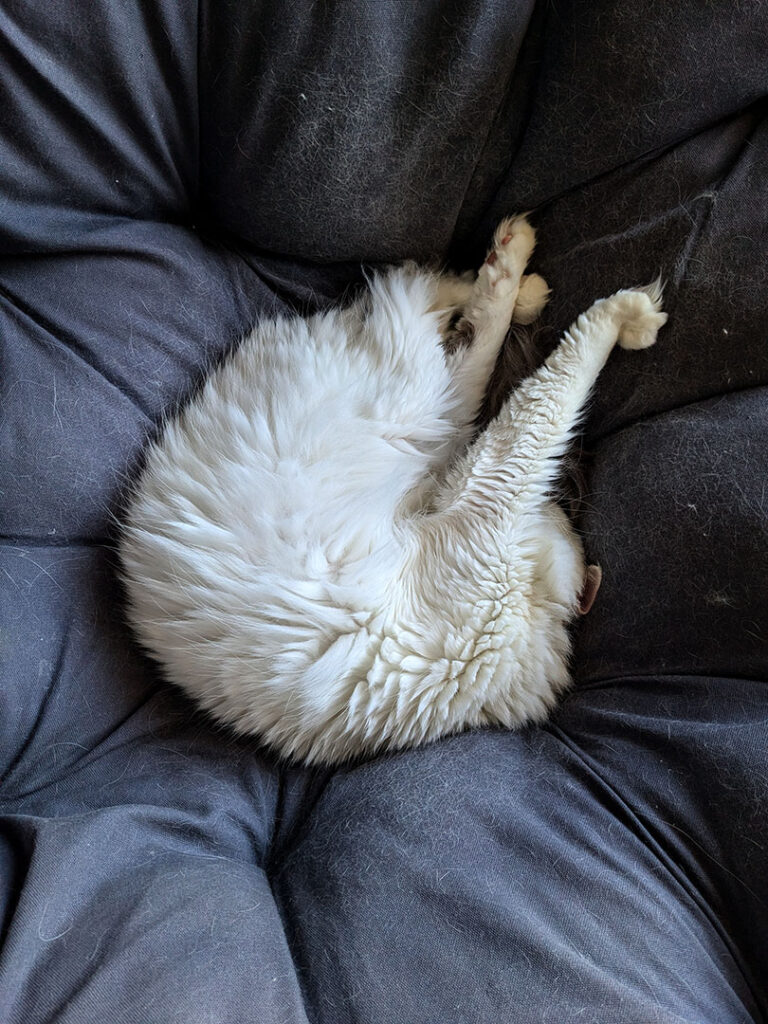
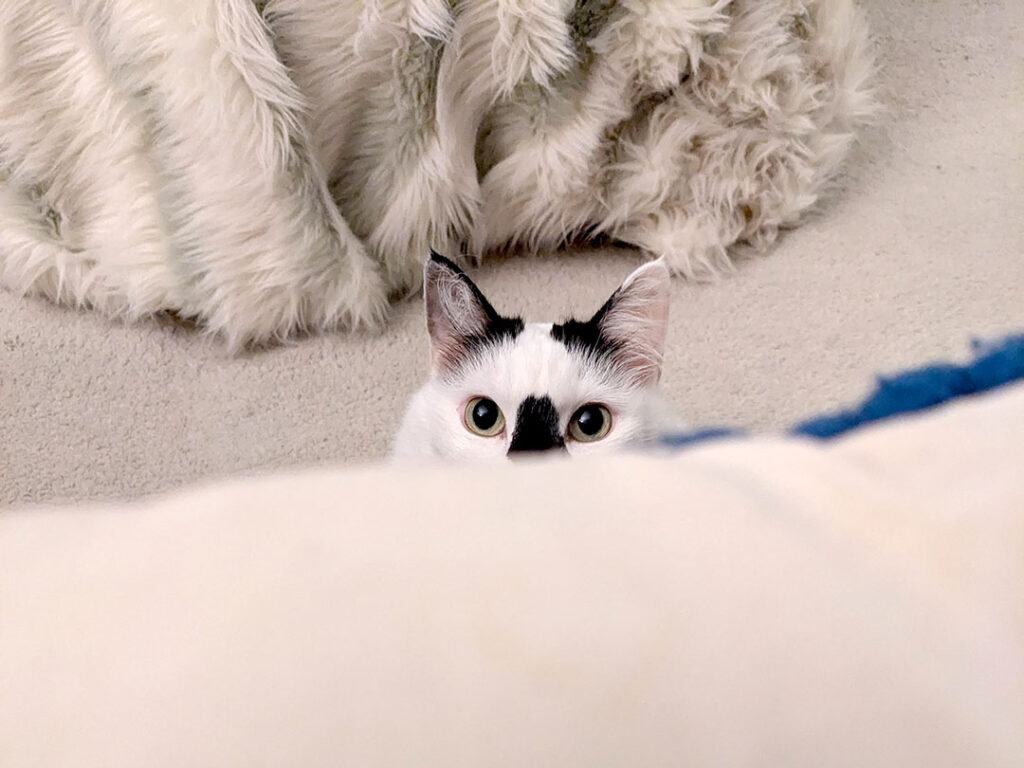
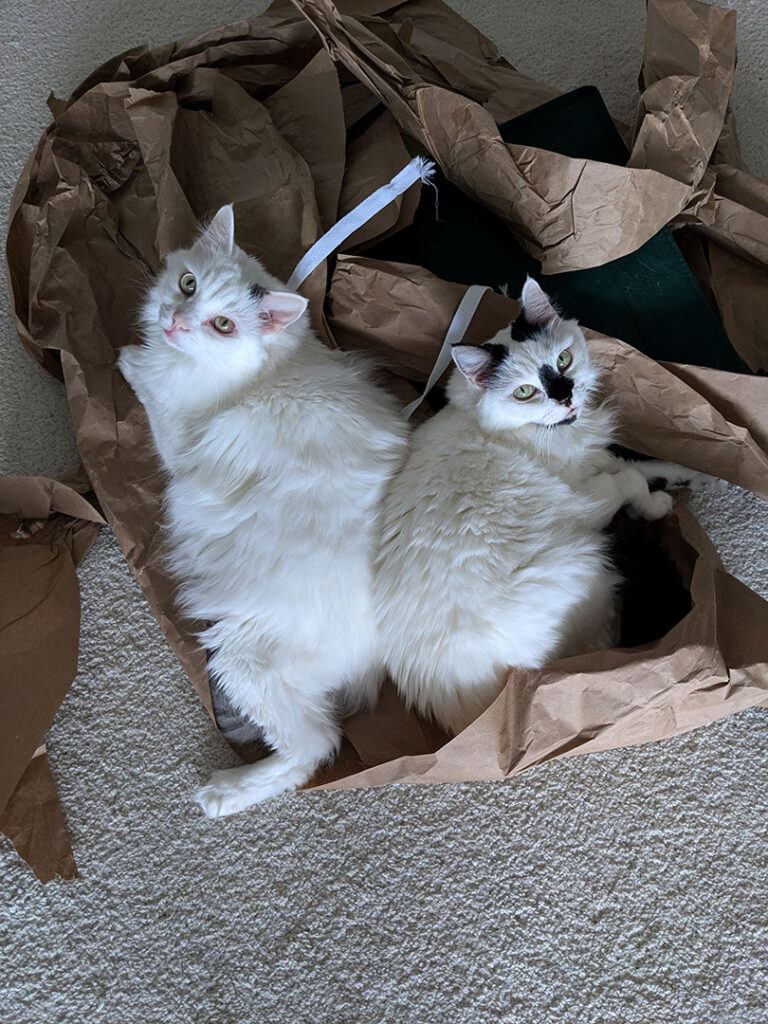
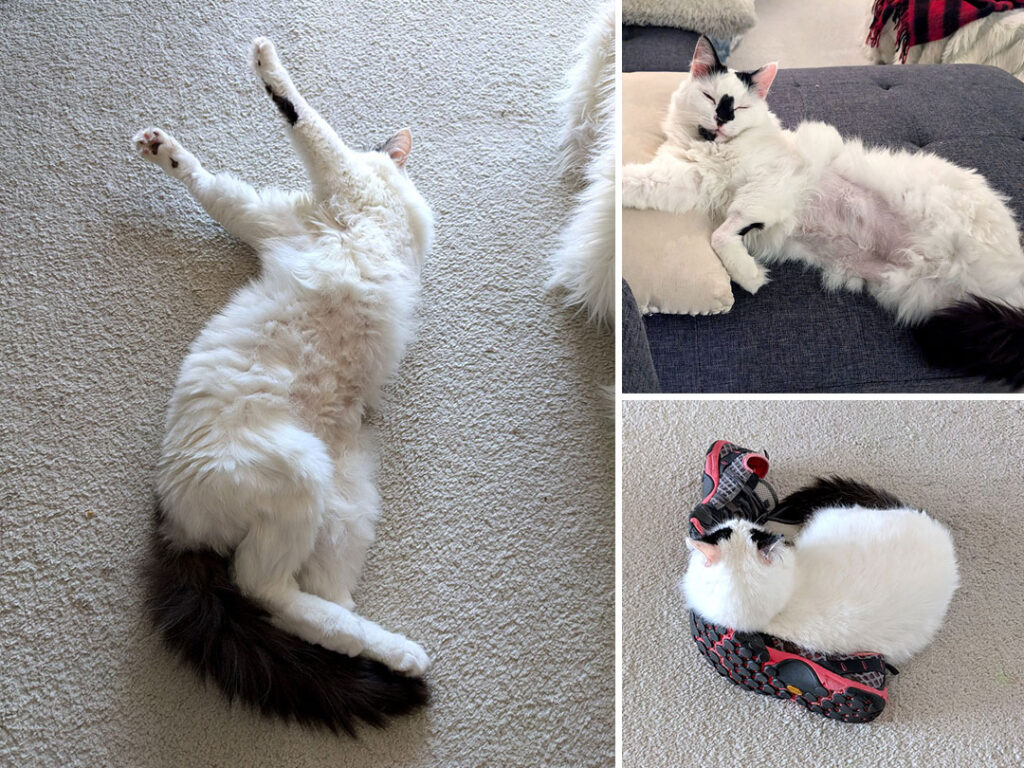
Because Dr. Maki worked at Irvine Pet Hospital and because Aldo from Pet Dental Solutions was willing to trade phone calls on the weekend, Violet got her ultrasound on March 18. It was a situation where the technician was visiting the hospital at some unspecified time that day, so they had me do a drop-off appointment where I left Violet with them first-thing in the morning and then picked her up just before they closed at the end of the day. (It was the longest Violet and Hugo had been separated, and I worried that Hugo might be looking for her. But when I got home I found him fast asleep–that’s the photo above–and I’m pretty sure he never realized she was gone.) Dr. Maki was at the Irvine Pet Hospital that day and was able to go over the results with the technician before he called me. “She has kidney stones,” he said. “She needs kidney bypass surgery. Go to UC Davis in San Diego. Let me get you their number.” Again, I didn’t realize it at the time, but this was valuable information that I doubt I would have gotten from most primary care vets. (A vet tech I talked to later had never heard of kidney bypass surgery, much less knew where to get one. And it takes a lot of guts to tell someone that they need to start trekking 90 miles to San Diego for cat care.) The kidney stone diagnosis was hopeful–kidney disease is chronic and just gets worse until the cat dies, but kidney stones might mean that Violet has a chance of getting better if the stones can be removed.
Of course it took me two trips to San Diego with Violet to realize the FasTrak hack. Well, one and a half trips. I signed up for FasTrak in the parking lot in San Diego so I could use it on the drive home. On a trip that long it can save 20 or 30 minutes depending on the traffic situation (especially if you take the 73 toll road). It was mainly the drive back home that was the problem. The drive down to San Diego was magical. You hit the coast just before San Clemente and then drive through that undeveloped section by Camp Pendleton before hitting civilization again back in Oceanside. On our first trip on April 2, the hills were still green and there were low misty clouds floating across the freeway from the ocean into the hills. It’s a stunning corner of the world.
For Violet’s kidney stones, he explained that she has a large stone nearly blocking her right ureter (the tube between the kidney and the bladder) and that it could become fully blocked at any time (which means a trip to ER). But despite the dire ureter situation, he felt that it was worth it to try to get her to pass the stones (there were some in her kidney as well) in the hope that the surgery could be avoided. He prescribed Prazosin (to relax the ureter and hopefully release the stones) and Meloxicam (to relieve inflammation). Prazosin was originally used in humans to reduce blood pressure by relaxing blood vessels. It seems like a lot of the cat care stuff was originally something for humans. The weight scales at some of the vet offices are human baby scales, and the blood pressure cuffs they use on cats are the ones they use on human babies. (You can take a cat’s blood pressure just like a human’s by putting the cuff on a limb, or you can put the cuff on a cat’s tail which I thought was cool.) Then Dr. Le Sueur says, “Did they tell you she’s anemic?” No, no they did not. So he also prescribed Varenzin, which works by tricking your body into thinking you’re hypoxic (low oxygen), so your body produces more red blood cells to compensate. After talking with Dr. Le Sueur and hearing his treatment plan, I okayed the tests/ultrasound he wanted to do that day and then met with the pharmacist to pick up the Prazosin, Meloxicam, and Varenzin. At UC Davis Vet Med the pharmacist comes out of her office and sits next to you in the waiting room. She holds up each type of medicine and explains a little of its history and how it works and what the possible side effects are and then tells you how to administer it (how often, what dose, what method, and alternative methods if the cat is not tolerating the first method). You have plenty of time to ask questions and you are basically guaranteed to know what you are doing by the end of your pharmacy session. I’ve never experienced such white-glove pharmacy service. Usually they hand you a bottle and you read the label and do your best. After meeting with the pharmacist, I met with Dr. Le Sueur again to go over the results of the lab work they’d done that day. With the two meetings with Dr. Le Sueur, Violet’s labs and ultrasound procedures, and the meeting with the pharmacist, our first visit to UC Davis Vet Med lasted four hours. (The second appointment was six.) It’s insane that the level of care Violet got is out of the question for people.
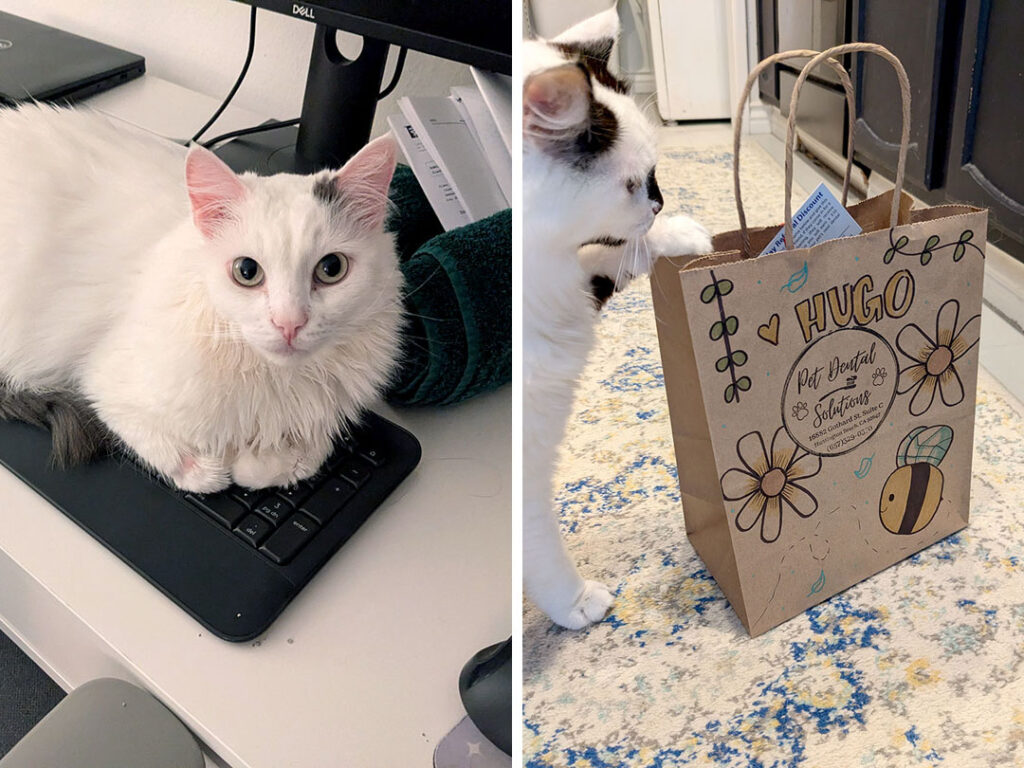
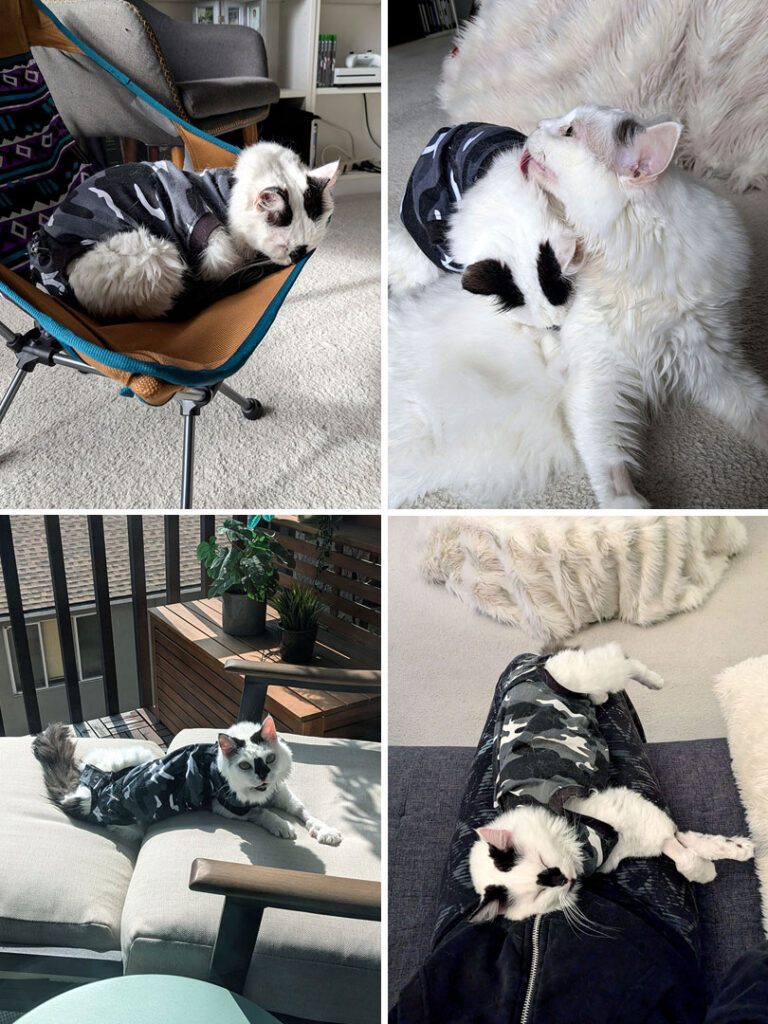
Pet Dental Solutions took good care of Hugo for his surgery. They have you drop the cat off in the morning, then they call you once he’s under anesthesia, then they call you again once his surgery is over and let you know what time to pick him up. The photos above are of post-op Hugo (you can see his wrists are shaved for the IVs), and the bag Pet Dental Solutions made for Hugo’s post-op care. The bag has his pain meds (Gabapentin) and his anti-inflammatory/pain meds (Onsior) and some goodies like a toothbrush and mouth rise. When I picked Hugo up, they had me meet a member of the surgery team in the consult room for a report on the surgery. He had a laptop so we could look at Hugo’s x-rays. Cats have 30 teeth, and Hugo needed 24 extracted. Basically if the tooth moves or wiggles the surgery team will cross-references that with the x-ray to decide whether to pull a tooth or not. Hugo’s x-rays showed a lot of ghostly teeth roots, like the teeth had been dissolved and only the faintest outline remained. So that question from earlier, about why the dental treats weren’t doing anything? It turns out both cats have stomatitis, which is like an autoimmune disease where your body attacks your teeth and dissolves them. Modern medicine doesn’t know a lot about stomatitis in cats or why it happens or what causes it. The surgery team member said it seemed to be happening more often, and that it was affecting a lot of dogs now as well as cats. His (self-admittedly uneducated and unfounded) opinion was that it seemed to coincided with the rise of the grain-free trend in pet food. (And I had indeed been feeding my cats a brand of food that happened to be grain-free. I doubt there’s any research to support the grain-free theory at the moment, but give it a few years and maybe something will become obvious.) The other theory was that stomatitis is genetic and the cats got it from their parents. The surgery team member also believed that brushing the cats’ teeth this whole time wouldn’t have made a difference–the only treatment for stomatitis currently is to pull the cat’s teeth, so we still would have ended up with both cats needing surgery. So it’s good that Hugo got all his teeth pulled at once rather than having to do multiple surgeries over the years, and it’s possible that he’ll need another surgery in the future because he still has six teeth that could start to dissolve. Dissolving teeth is also why you take the cat to a dental specialist–there’s tons of little tooth fragments floating around, and they need to scrutinize the x-rays and make sure they get every sliver. Leaving any tooth bits can cause problems that can lead to more surgery.
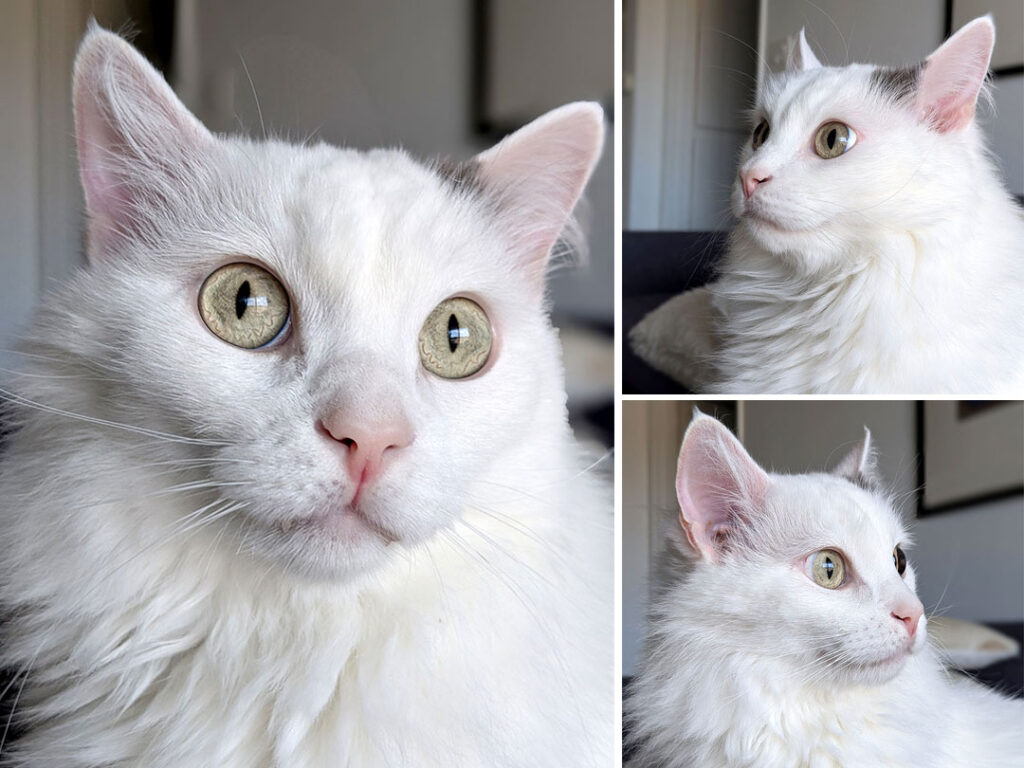
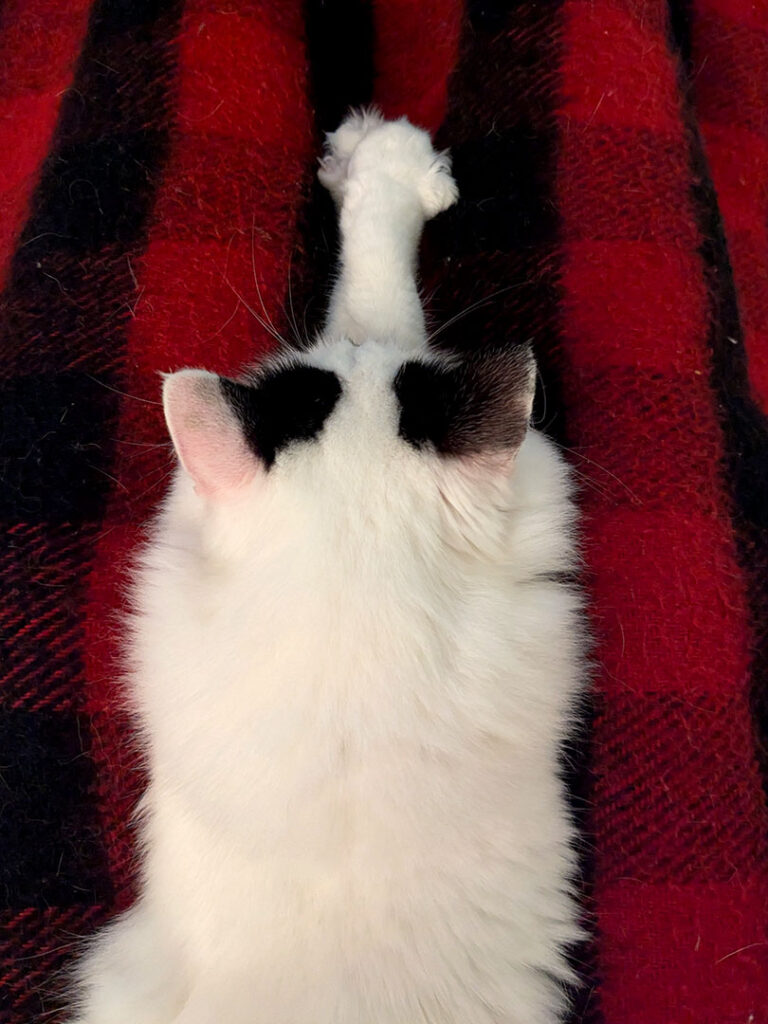
But regardless of why it works that way, the fact is that I was desperate for an ultrasound anywhere in Southern California on the seventh day (April 9). I thought about calling in another favor to Pet Dental Solutions and Dr. Maki (Irvine Pet Hospital wasn’t returning my calls, so I thought a vet might have better luck getting through), but Dr. Maki had left Irvine Pet Hospital to start his own hospital in Costa Mesa and was still in the middle of getting that set up and going. So I felt I had no choice but to go back to San Diego and just have UC Davis do it. I called their receptionist who reminded me that the ultrasound is technically done next door at Vet Specialty Hospital and I’d have to make the appointment directly with them. So I called Vet Specialty Hospital and explained that Violet was a patient next door and they’d recommended her for an ultrasound. I got the response that I’d heard many times at that point, “Well if she’s not an existing patient, we can’t book an ultrasound.” That moment was the most panic I felt over the cat stuff this year. That was Violet’s last chance for an ultrasound, and she wasn’t going to get one now, and it was only a matter of time before that stone moved and completely blocked her ureter and sent her to ER where a unfavorable outcome was likely. Nearly in tears I called UC Davis back and begged for help. “Hi I just called to book an ultrasound and you sent me next door, but they won’t do it since the cat isn’t an existing patient and I’m not sure what to do at this point and I think I need help.” The receptionist told me to hang on, and then she was gone for a long time. When she came back she explained that she’d had to walk next door and book the ultrasound directly with the nurse. But she got it done. Violet was getting a second trip to San Diego on April 9.
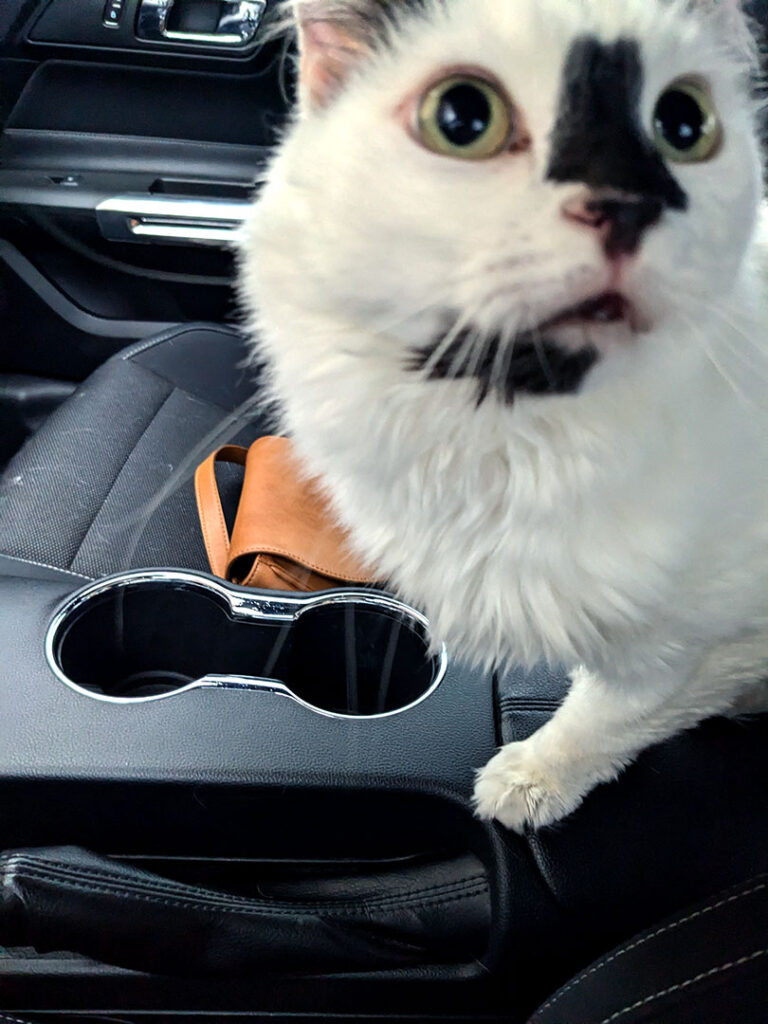
So I bought some surgical recovery pajamas for Violet, packed her food and her meds into her backpack, and dropped her off for surgery. The photo above is blurry, but I love it. I took it in the parking lot just before we went inside for drop off. You’re not supposed to let the cat wander the car while you’re driving, but I’d let her out at the Aliso Creek rest stop so she could see something other than the inside of her cat carrier backpack for the rest of the drive. I took the picture just in case I didn’t get to see her again.
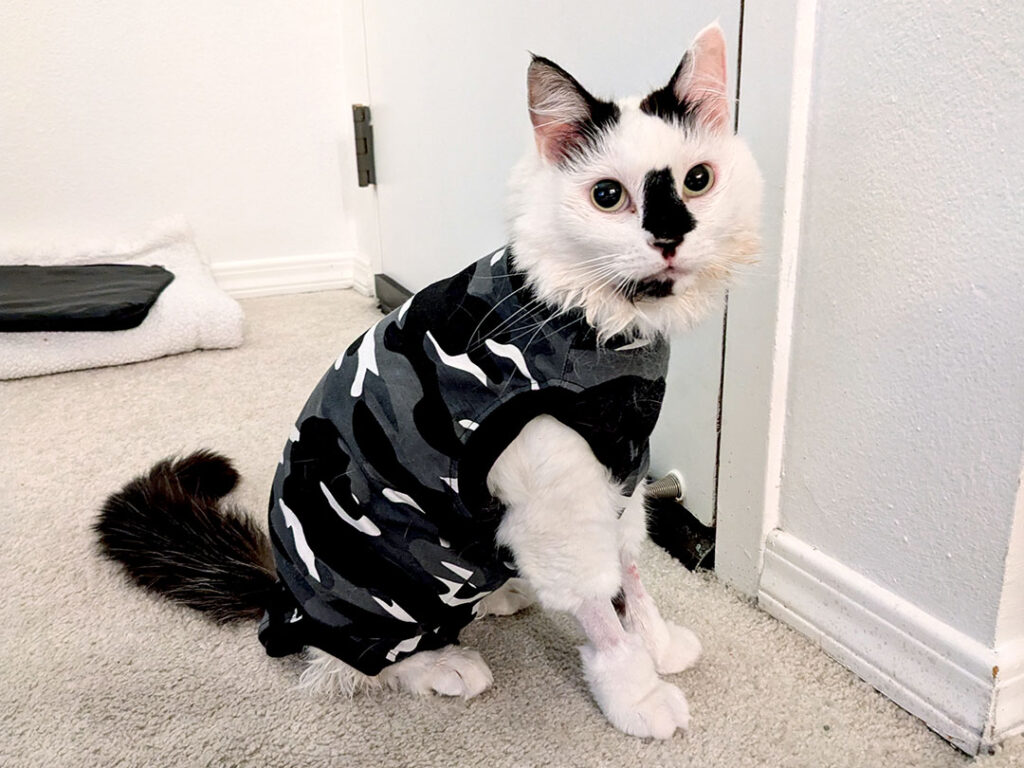
So I got to weigh Violet’s mental health after being locked in a room or a playpen for two weeks versus the chances that she’d try to play and jump when her body was telling her to rest and recover. It was a chance to practice trusting my gut. (I would run into this later with Hugo and cones. Hugo is so sedentary that he won’t bother the affected area, and I knew that and tried to tell the doctor that. But they just know to prescribe constant long-term cone use. I went with my gut and removed his cone all the times they prescribed it. And I felt guilty each time. But Hugo did indeed not bother the affected area even with the cone off, and his mental health was better because he was able to sleep, eat, and move normally.) It’s tricky because you’ll be both wrong and right. Like letting Violet out in the car is not recommended, and it did decrease her anxiety, but you could argue that I got lucky that there was no car accident. Similarly, I was right and wrong with Violet’s post-op jumping. I was wrong in that she did attempt a jump, almost immediately when we got home, but I was right in that she didn’t try jumping after that. I ended up compromising by closing the bathroom door (Violet likes to jump onto the sink), but letting her roam the living room/kitchen as usual. Was that the best choice? No idea.
At Belmont Shore the back-of-house visit with the vet tech and Dr. Pador was fine. They looked at Hugo and prescribed Tresaderm ear drops. I went to the front desk and paid, and they said Hugo would be right out, so I went back to my seat in the lobby. A long time when by. Eventually I got a text message from Belmont Shore Vet Hospital: “Hey we still have your cat.” I instantly realized that they’d kept me waiting there and Hugo waiting in the back because they had no idea I was in their lobby. They’d interacted with me while I paid, and then my face had vanished from their minds almost immediately. Still holding the phone, I leapt from my seat and charged the front desk. From the expression on the receptionists’ faces I could see they realized their mistake, which infuriated me more. I absolutely lost it. (Which for someone as affected by Good Girl Syndrome as me means that I get blunt but remain civil and sort of monotone.) “You didn’t want to call Hugo’s name? You didn’t want to call my name?” I asked, alternating looking at each of them. And internally, You don’t know your own lobby? You didn’t think to look in your lobby? You didn’t even want to try? Out loud I finished with, “Do people just leave their cats?” One thought for a second and said, “Well, no.” Then she laughed, like “What a funny miscommunication, what are the odds?” I knew whatever I said next would be something I’d regret, so I silently accepted Hugo’s cat carrier and left. After I had Hugo stowed away in the Mustang, I sat in the driver’s seat and tried to crush the steering wheel in my hands, trying not to think about how Hugo had been stressed, anxious, and stuck in his cat carrier for that long for no reason. I counted until I was calm enough to drive. Belmont Shore is no Pet Dental Solutions or Vet Med Center, but they are the main game in Long Beach, and I would end up having to see them again.
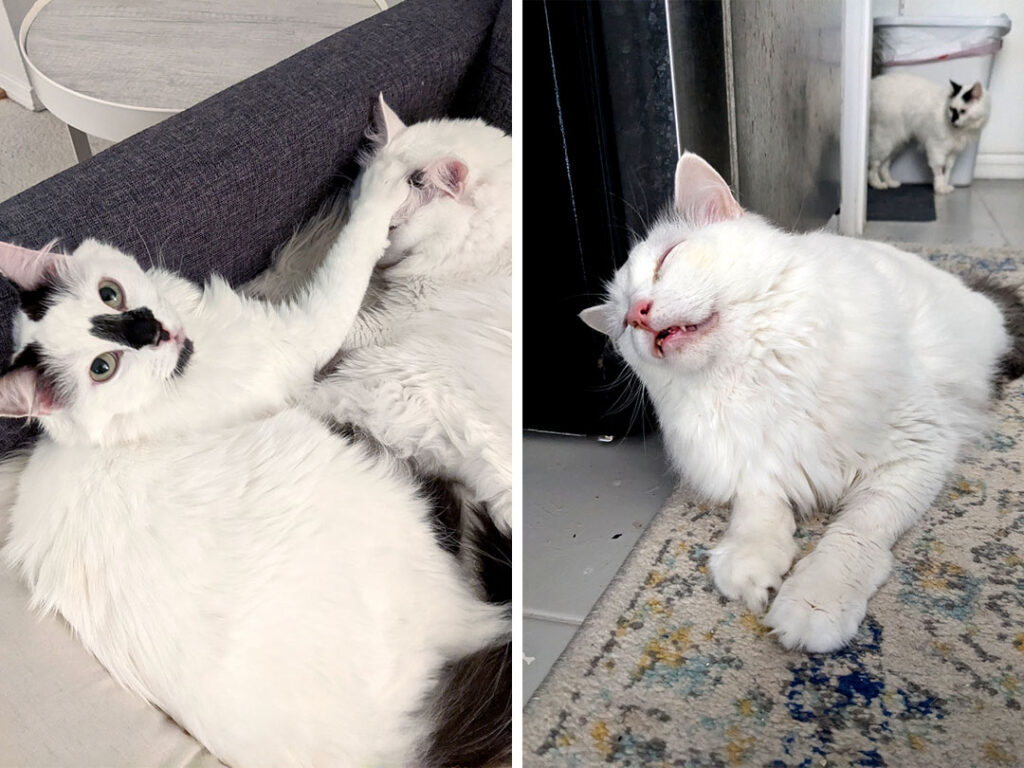
Now that Violet had her dental surgery done, her Gabapentin days were wrapping up quickly. My plan was to follow the Gabapentin schedule set out by Pet Dental Solutions for her post-op care, and then slowly wean her off the drug using whatever Gabapentin I had left. That would make her Gabapentin-free at some point during the second week of June. The only other thing I had to worry about was some blood tests that Dr. Le Sueur had recommended–ionized calcium, and PCV (to check for anemia–Violet had already needed two rounds of Varenzin, so hopefully the anemia was gone now). He said I could get them done closer to home. I called around and found out that Vetco doesn’t offer either of those tests. The place that does? Belmont Shore Veterinary Hospital. Ungh. I thought it through and figured that the issue with Hugo could be prevented. When they say, “We’ll bring your cat out in a moment,” DON’T go sit back down in the lobby, just hover until you see your cat. (I’d seen another woman do that on my last visit.) Uncomfortable? Yes. Effective? Maybe, I guess I’ll find out. So I called them. “You’ll have to do a new patient consult with the blood tests.” Dear lord, fine. Dr. Pador was less-than-pleased that Violet had all this medical history and I just wanted him to do the blood tests based on me claiming that someone in San Diego said so. Eventually we realized he was familiar with UC Davis Vet Med, he’d actually worked there at one point. Did that ease his discomfort that I’d failed to catch him up on Violet’s entire medical history? No, not at all. But he did get the blood tests going. This was the visit where I ran into the vet tech who’d never heard of the SUB procedure, which made me feel less-than-confident. They gave me an estimate of 10-15 minutes for Violet’s blood tests, which turned out to be more like an hour. But at least the receptionist brought me my cat this time. (They remembered me now, they even knew I was “Hugo’s mom” even though Hugo wasn’t at this appointment.) As I left, the vet tech (who’d I’d explained the SUB system to earlier) held the door for me and said, “It’s so cool that you did that.” The good news was that Violet’s ionized calcium levels were normal, the bad news was that she was still anemic and needed to do one more round of Varenzin. So that should be it. Hugo’s teeth and ear were taken care of, Violet had done both of her surgeries, so I just needed to wean Violet off Gabapentin, and do one more round of Varenzin, and that’d be it.
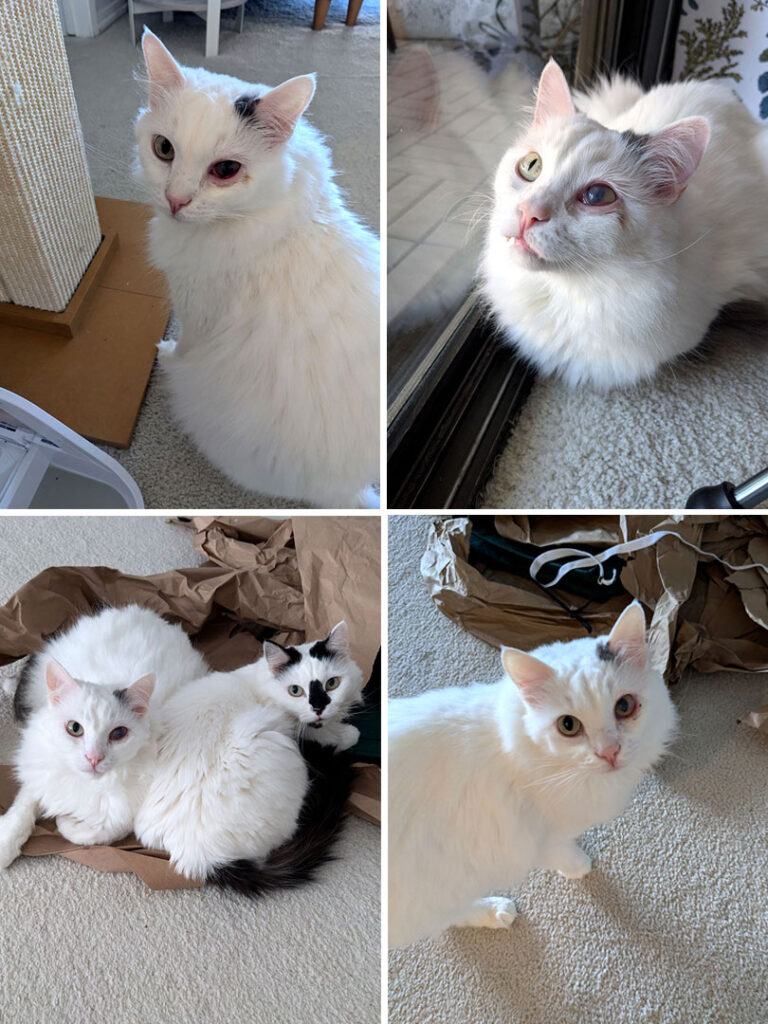
Dr. Konrade confirmed Dr. Ingram’s diagnosis and explained that there’s a couple reasons why Hugo’s cornea might be slow to heal. It could be some sort of auto-immune situation (which they would test for) or it could be the herpes virus. Usually it’s the herpes virus, in fact it’s so likely that it’s the herpes virus that they just start treating the cat for that while they wait for the results of the auto immune test. (It did indeed turn out to be the herpes virus in Hugo’s case.) Dr. Konrade started Hugo on a small army of drugs: continue the Oflaxacin, add the antiviral Odoxuridine eye drops, add Terramycin ointment (antibiotic), add sodium chloride ointment (draws excess fluid out of the cornea to aid healing), and start Hugo on Famciclovir pills (antiviral). A cat’s eye can handle only one eye drop at a time (or one smear of ointment at a time), so you need to wait at least five minutes between each medicine (and 20 minutes before doing the sodium chloride). So I was doing Hugo’s eye routine for nearly a half-hour three times a day. My phone’s clock app was filled with “Hugo eye routine” alarms. The only thing I could not figure out was the Famciclovir. It’s a large pill, even by human standards. I overnighted myself a pill cutter, and that didn’t work (Hugo could avoid swallowing the pill fragments until they’d turned to mush), so I overnighted myself a pill crusher and sprinkled the pill over his food (that didn’t work, Hugo is sensitive to anything that’s off about his food–he won’t even eat other flavors of food). So I called Eye Care for Animals to ask for help. Maybe there’s a liquid form I can feed him in a syringe? Initially they sent me this video, which blew my mind and which I plan to use if I ever run into this situation in the future. But then they said to just skip the Famciclovir and use the Idoxuridine as the antiviral. They wanted me to keep that routine going and then do a follow-up visit in four weeks.
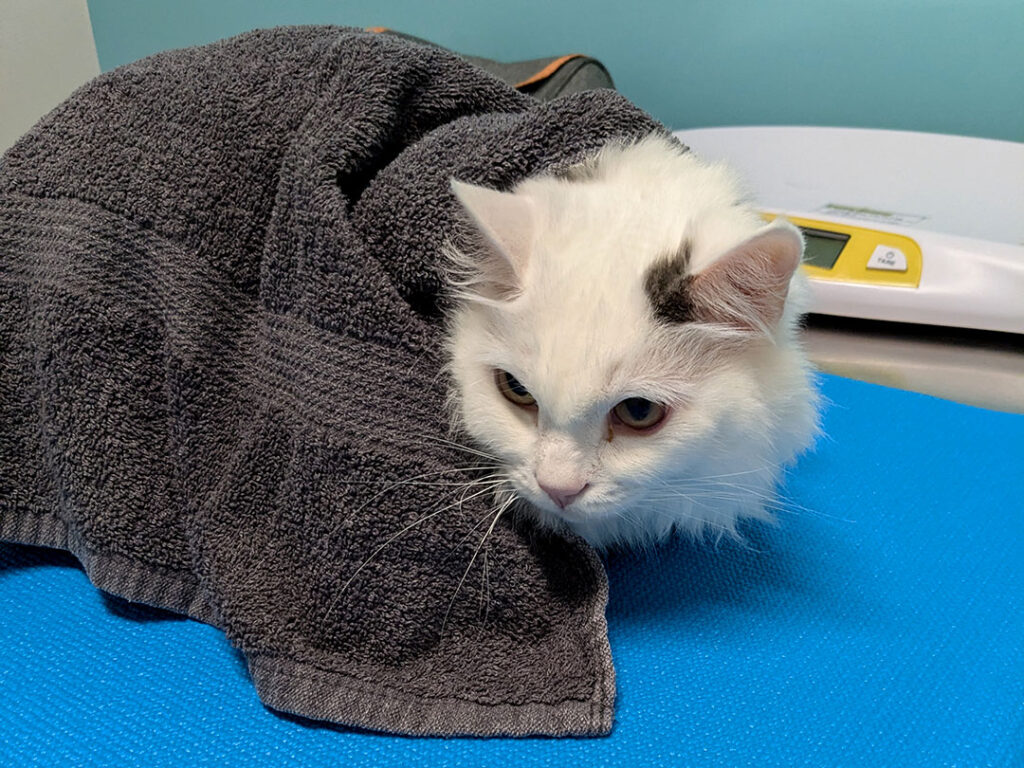
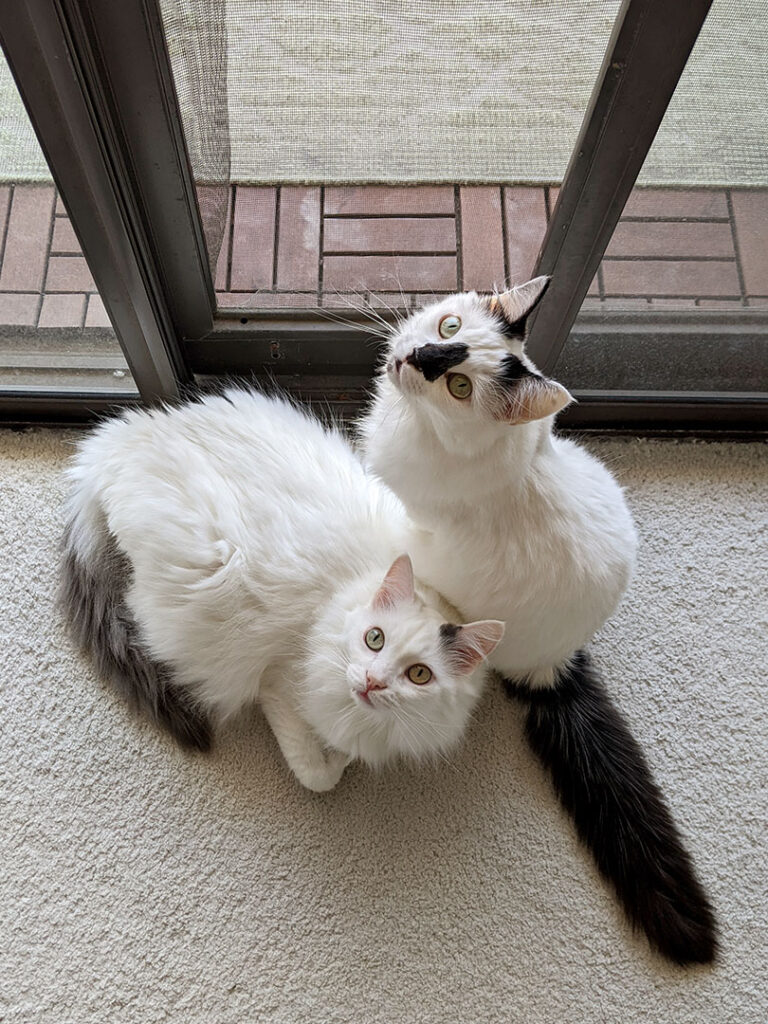
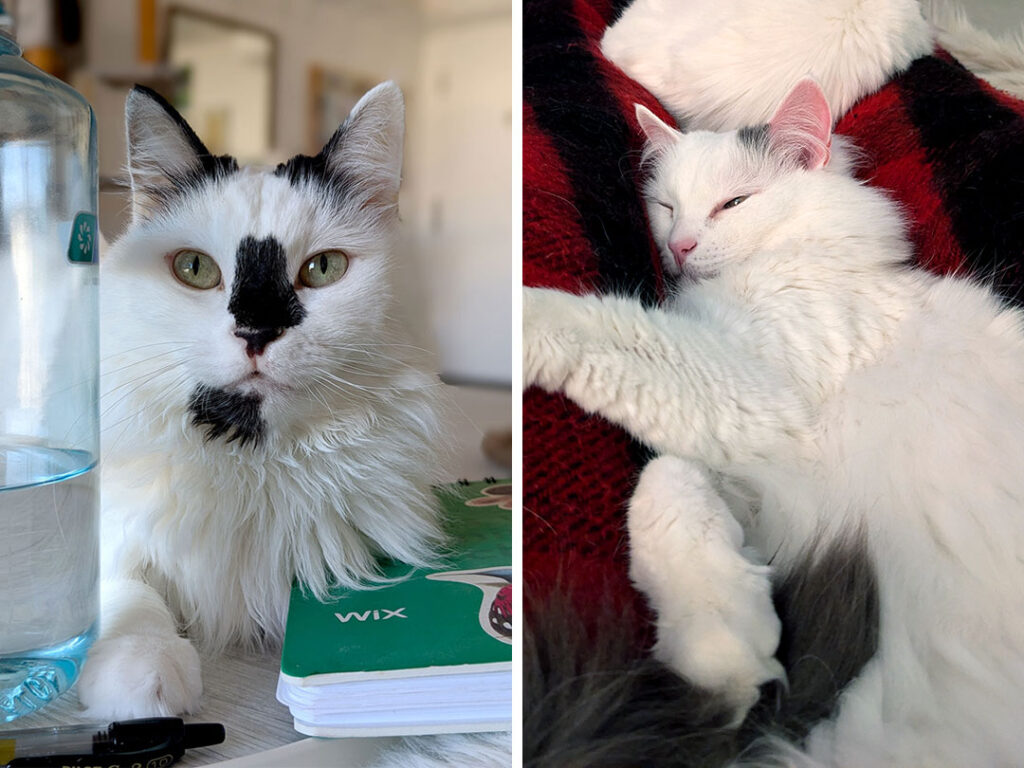
What’s happened next:
- High BP Violet had routine teeth cleaning September 4 then a SUB flush September 5. She had scary-high blood pressure at the SUB flush, so they said to follow up with primary care–maybe it was stress-related from the drive to San Deigo
- Ear infection Hugo got a second ear infection, so both he and Violet visited Belmont Shore on September 11, Hugo for ear drops, Violet for the follow-up BP check (her high BP turned out to be a false alarm, it was normal at the follow-up 🎉)
- Cystitis On the morning of September 24, Hugo was having trouble peeing. He’d try and only a few drops came out, so he’d give up only to be back a few minutes later to try again. Urinary blockage is common in male cats, and it can be deadly. The amount of toxins that are building up in your system when you can’t pee can kill you in 24-28 hours. So I updated my status at work and hauled Hugo to the ER. Fortunately there was no wait this time–they had already switched to the morning shift and his condition was potentially severe, so they saw him right away. He wasn’t blocked! It was a good thing, they said, because a blocked cat is EXPENSIVE. Turns out he had cystitis, which is basically bladder irritation. It makes you feel like you have to pee when you don’t. (Violet gets cystitis for a few days when she’s just had a SUB flush.) Even though it was fantastic that he wasn’t blocked, cystitis is not fun. Hugo had a particularly bad case where his bladder was so inflamed that it was bleeding. A lot. Like he looked like he’d just had kittens. The wild thing is that cystitis is idiopathic–they have no idea why it happens. They think it’s likely due to stress. “Has Hugo had more stress this year than normal?” the vet asked when he met with me. Hahahahahahahaha, oh, um yeah, he has. Since there’s no root cause, the vet just sent him home with Zorbium and 10 days of Gabapentin while we waited for the inflammation to go down. Fortunately it did, and relatively quickly as Hugo was back to normal about four days later.
- Holidays The Year of the Cats gave us a break over the holidays from Halloween to New Year’s.
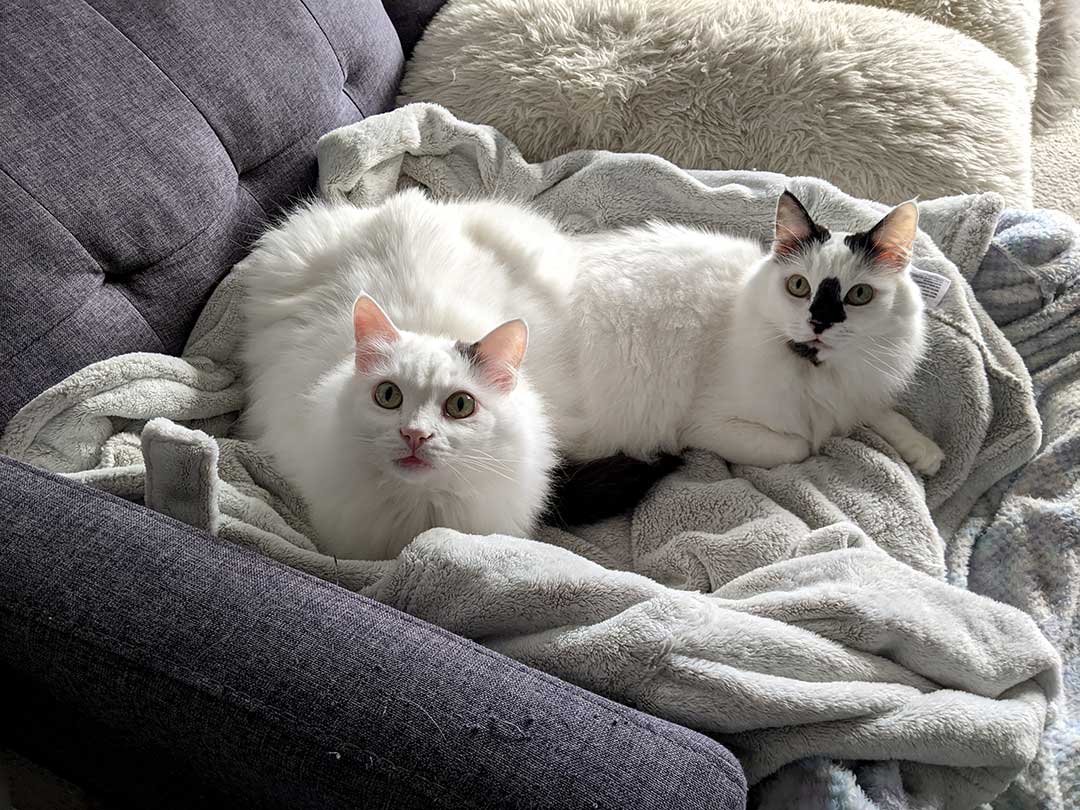
- Cystotomy Violet and I headed to San Diego on January 8 for her first SUB flush of 2026. Her values were excellent, she was in the range of a cat that doesn’t have kidney disease. But when I met with Dr. Le Sueur afterwards, he said “You might want to think about getting her bladder stone taken care of.” Wait. WHAT BLADDER STONE? It was so out of left-field that I thought he was talking about kidney stones at first, like he was saying she had stones on her other side and it might be time to do a SUB on that side too. But no, he didn’t say kidney, he said bladder. “I don’t think I knew there was a bladder stone,” I said. He explained that they’d been watching it since April and that it had grown from 3 mm to 5 mm in that time. I had a million questions like, Why is this the first time I’m hearing about this? Why didn’t we take care of this when we were ALREADY IN HER BLADDER for the SUB surgery? Where did this stone come from? Does she have any other stones? I only asked the last question out loud. Dr. Le Sueur said that although she does have other stones, they are firmly lodged in her kidney walls and don’t seem to be moving, so there’s hope that we’ll never have to deal with them. He then showed me a picture of her bladder and, yep, there’s obviously a large white mass in there. Getting the stone out means another surgery, called a cystotomy. It wouldn’t be as big a deal as the SUB surgery–the surgeon just makes an incision, goes into the bladder, and gets the stone–and since it’s fairly common I could probably even get it done in LA. He said to give him a week to get Violet’s medical records updated and ready to send to the surgeon, and that’d also give him time to ask around and find a surgeon closer to me that he could recommend.
So Violet and I headed home. Dr. Le Sueur said she’d be acting weird for 24 hours because they’d sedated her at the SUB flush. When we got home she just wanted to sleep. She wasn’t eating or drinking. She had cystitis like normal, where she pees frequently or feels like she has to pee when she doesn’t. But then she wasn’t peeing at all. Normally she pees at least a few drops, but Friday night she started peeing nothing. She still wasn’t eating or drinking. And because I was expecting her to be weird, and because cystitis is normal, and because I’d just seen a scan of the stone clearly NOT blocking her urethra, I ALMOST DIDN’T TAKE HER IN. I was in bed, contacts out, pajamas on on Saturday night, and my gut was screaming that something wasn’t right. She hadn’t been eating or drinking for 48 hours and hadn’t peed for 24 hours. So I got out of bed, got re-dressed, and lifted Violet in her blanket and set her in her carrier. It was immediately apparent she was in bad shape because she didn’t panic or complain about the carrier. Much like when Hugo was in ER for not peeing, Violet’s case was prioritized. (She was second after a dog about to go into heart failure.) They saw her quickly and then sent the on-call vet out to meet with me. VIOLET WAS COMLETELY BLOCKED. Her bladder was not full-to-bursting, but it was really full–hard and painful to the touch. The toxins in her blood/urine were so high that their machine couldn’t measure them. Her phosphorus (which can randomly stop your heart if it gets over 7.5) was at 8. I couldn’t believe it, partly because I’d just seen proof that the stone was nowhere near her urethra, and partly because this doesn’t happen to girl cats. (The ER doctor said this is the first girl cat he’s seen it happen to. Great.) So Violet needed emergency surgery to remove the bladder stone blocking her urethra.
The problem was that neither that vet nor any of his colleagues felt comfortable doing a cystotomy on a cat that has a SUB. I’d need a specialist. And I’d need to find one immediately. They could unblock her and send her home, but she might just get blocked again. It’d be better to put her on a catheter and fluids and leave her hospitalized until the surgery happened. Well, who’s a good specialist around here? He didn’t know. He thought maybe this place or this place, but it’s really up to me to 1) find someone who was qualified and willing to do it on a cat with a SUB, 2) convince this person to do the surgery ASAP. (Remember my front-of-house/back-of-house rant from earlier? This is a good example. The back-of-house thinks it’s easy for a non-vet to book emergency appointments, and the front-of-house has no problem reminding you that you and your “emergency” can’t jump the queue. It’ll be 2-8 weeks until your appointment just like everyone else.) Neither that man nor the man who came on overnight were able to help me with a surgeon. Fortunately Dr. Kerr came on in the morning. When she called we logicked our way through the situation and by process of elimination decided that it’d be best for Violet to go back to San Diego for surgery. She said there was no question we’d have better luck if she attempted to book the last-minute surgery than if I attempted to book it. “Let me call you right back,” she said. When she called back she’d contacted Veterinary Specialty Hospital in San Diego, booked the surgery, arranged a direct transfer, let them know about Violet’s catheter and what connections they’d need to hook her up when she got there, and she had vocab for me to use and names for me to drop to ensure that the intake process in San Diego went smoothly for non-vet me. I was weepy with relief. When the Long Beach ER called back a few days later to check on Violet, I asked them to thank Dr. Kerr because I’m pretty sure Violet’s surgery wouldn’t have happened in a reasonable amount of time without her.
Vet Specialty Hospital is also an ER, so there was a question of if Violet could get in immediately or not. The best chance was for me to take her Sunday night when they had three doctors rather than Monday morning when they had one. By the time everything was arranged it was around 10 pm Sunday night. So I headed for Long Beach Animal Emergency to pick Violet up (Dr. Kerr and the folks on staff had Violet and her catheter and her bladder bag and her e-collar all arranged in her carrier for the trip, so I just had to put her in the car). For the first time since I’ve been doing this drive, the traffic was insane. Of course it was. The first accident had traffic across all lanes completely stopped (there was a car upside down), but it started moving almost as soon as I got there. The second accident though … it was in Dana Point, and I got there just as the ambulances were getting onto the freeway. I watched the ambulances disappear around the corner way up in the distance and knew we had a lot of cars to move to get past this accident. Traffic across all lanes was completely stopped again, except for the far right two lanes which were exiting. I sat in the same spot in the fast lane for about 20 minutes trying to figure out what to do. I was a feline ambulance with no lights or sirens or power of any kind. Then the car in front of me just … turned right. They pulled their nose into the next lane and slowly inched their way around until they were driving perpendicular across all the lanes, just slowly pushing from one lane to the next until they got to the exit lane on the far right. So I did the same thing. It was like driving across a parking lot. I got some shocked looks, but it worked. I was able to exit and take a parallel surface street and get back on the freeway a couple onramps later. I could see the lights from the emergency vehicles, but never saw the accident.
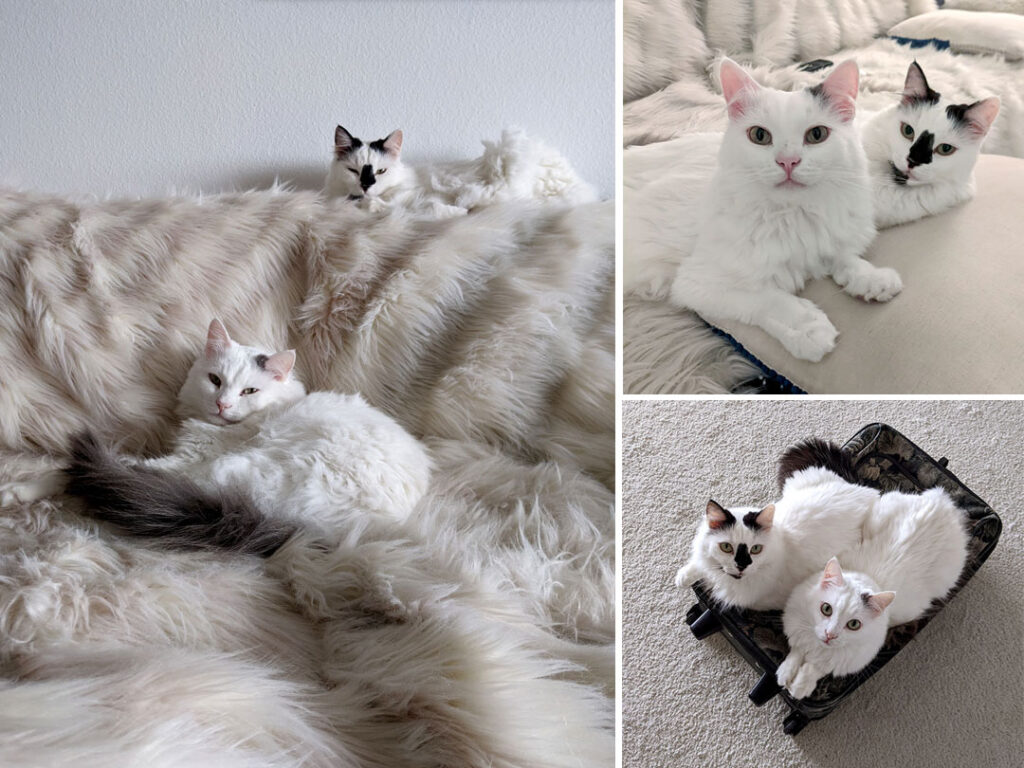
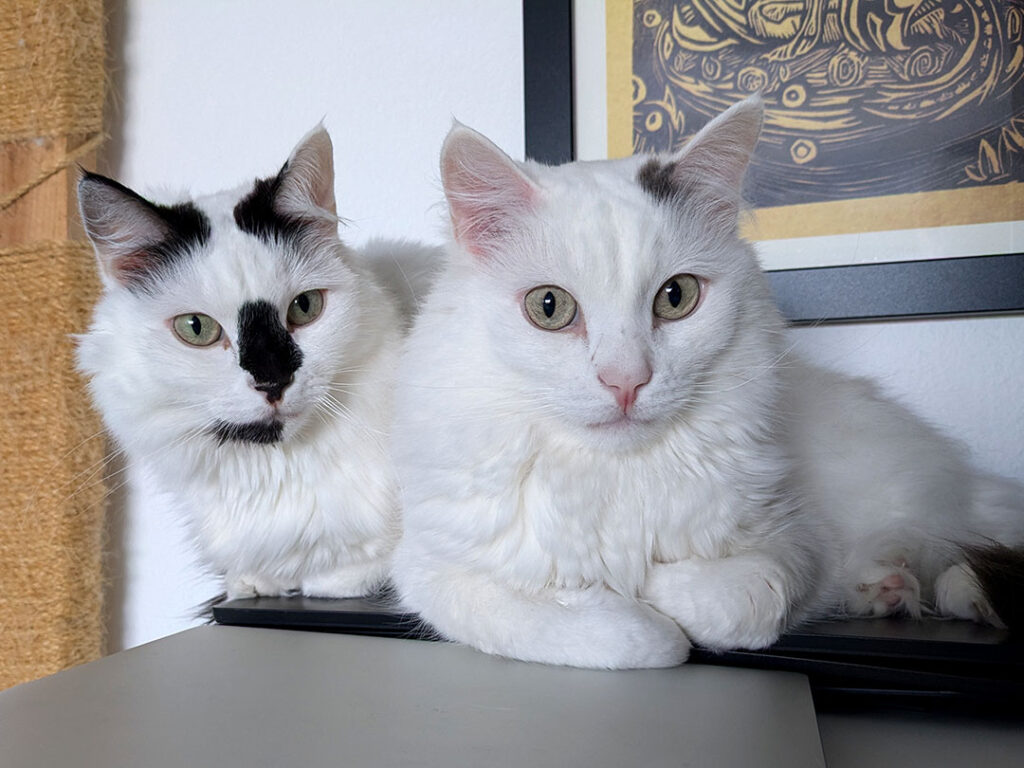
By the time I got to San Diego it was creeping up on 1 am. They were expecting us, which was another huge relief. They knew who I was and why we were there, and they got us into a room immediately. It became clear that they were going to start Violet’s case from scratch. Is her catheter placed correctly? Does she need surgery or are there alternatives? So they got a full history from me and then planned to do their own scans/blood/urine work to check her values. It was like an automatic second opinion, which I appreciated, although I had no doubt Violet would end up in surgery. Much like the situation where they couldn’t do her teeth surgery until her kidney values improved and she was qualified for anesthesia, the Vet Specialty folks had to check Violet’s levels multiple times before they could do the surgery. If they put her under anesthesia immediately it would do even more damage to her kidneys. So they planned to watch her for a few days and do the surgery when it became possible to put her under anesthesia. They asked if I wanted to see her x-rays with her SUB in place. It was fascinating–you can see the kidney and bladder and the SUB tubes and the port, and it’s crazy that someone thought of that and that it actually works. It helped wake me up a bit as it got my brain churning. Finally they asked if I’d like to say goodnight to her, so they brought her in and it was one of those moments where I wasn’t sure if I’d ever see her again, so I tried to memorize the spots of black she has on her ears and nose and chin. She was purring while I gave her neck scratches around her e-collar. The drive home was great. I got a second wind while looking at the SUB x-rays, I was the only car on the freeway at some spots (which felt wild), and I’d successfully delivered Violet to people who would take good care of her. I made it home at 3:37 am.
Violet’s updates were good for the next few days. She finally had surgery Wednesday evening. Dr. Pike called when she was going into surgery and about two hours later when she got out. (He opened the call with “You guys have really been through it this year, it’s incredible.”) They’d found and removed four stones. The only issue was that her bladder was so inflamed that it bled even if you touched it. And that can form blood clots which can also block her. So she went back on the catheter until her urine stopped showing signs of blood. It looked good Friday morning so they removed the catheter and waited to see if she was peeing okay without it, and she was! So I got to take her home Friday night. She was so happy to be home after being hospitalized with a catheter for a week. On the trip home she wasn’t moving around in her carrier very much until she heard me unlock the door to the condo, and then she got excited. She started trying to break out of her carrier, then once I let her out she ran around and checked on all the things–her food dish, her water dish, her water fountain, Hugo’s food dish, the litter box, the hallway, the pillows, the cupboards–it was like in Monsters, Inc. when Boo finally gets back to her bedroom and is so excited to show everything to Sully. Next Violet dove head-first into the food dish, then drank a lot of water, then peed and pooped (which are four out of four things I’m supposed to watch for as signs that she’s doing well post-op). Most exciting to me is that she’s so good at peeing now. I assumed she’d at least have cystitis after everything that’s happened, but she hasn’t been taking trips to the litter box when she doesn’t really have to pee.
It’s Sunday now, and Violet still seems to be doing well. So far she has been MUCH more comfortable than for her SUB post-op recovery. In addition to this surgery being less extensive, they also injected her with Nocita which is a 72-hour-long local anesthetic. She’s been able to curl up in a ball to sleep, she’s been her normal demanding self, and although she seems weak she doesn’t seem stiff and sore. She doesn’t mind her incision being checked or being lifted onto/off of things. And she seems cold, but not as cold as she did before. She’s been through it though, both forearms, ankles, and thighs have been shaved and have puncture holes (IVs? blood draws?) in addition to one shaved hip and a mostly shaved tail. Her belly and entire backside have been shaved, and her fur is matted in several places with substances I can only guess at. Her incision is about half the size of her SUB incision, and it looks good so far (you’re supposed to check it twice a day). She’s also been getting Gabapentin every 8 hours to help with pain relief. (The vet tech that handed her off at Friday’s pickup clued me in to the fact that gel caps are less traumatic than liquid Gabapentin, because the liquid tastes so terrible, so I’ve been practicing my cat pilling.) Violet spends her time sleeping in my lap, and she lets me know how much she disapproves whenever I have to stand up. The main concern now is how much this incident damaged her kidneys. It’s possible her values will never be as good as they were at her SUB flush last Thursday. So fingers crossed that she continues to recover well and that they like what they see at the recheck appointment.
Nellie!
I am speechless! I had NO idea what you have endured. I had no idea that cats can survive with many fewer teeth. I learned so much reading what you wrote. But my strongest emotion is profound respect and admiration for you. I was alternately astounded, teary-eyed, white-knuckled, and finally(!) smiling as each episode ultimately resulted in success. You did good. No one could have navigated through all of this better. You are amazing in every way. Hugo and Violet are the most fortunate cats I know.
So proud right now,
Mumsey